Bridging the Gap Between Discovery and Action
Influencer · Linkhut Team · 2026-06-22 · 5 min read
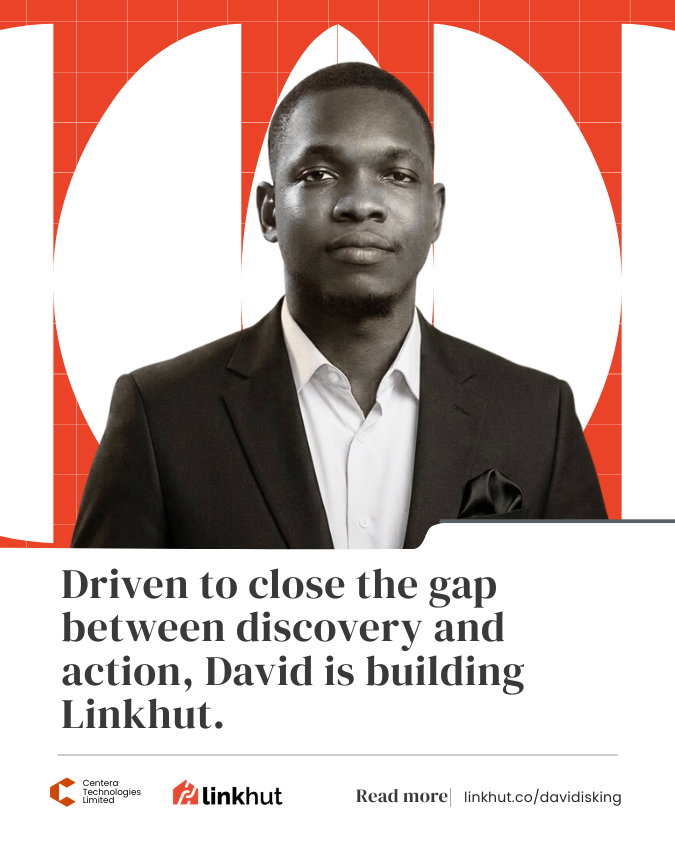
Bridging the Gap Between Discovery and Action
<section class="founder-story">
<div class="container">
<header class="story-header">
<h1>About the Founder</h1>
<p class="lead">
<strong>Onayemi Tosin David</strong> is a multidisciplinary product and growth professional whose work sits at the intersection of product design, branding, communications, and marketing technology.
</p>
<blockquote class="highlight">
<h3>"Why does so much digital attention fail to translate into meaningful business outcomes?"</h3>
</blockquote>
</header>
<br><br>
<p>
His understanding of this problem was built through experience rather than theory.
</p>
<p>
Throughout his career, he has worked with organizations across Nigeria and Africa, including
<strong>FBIS Technologies</strong>,
<strong>TreeKle</strong>,
<strong>Union Systems</strong>,
and several technology companies building products at the intersection of communication, growth, and digital infrastructure.
</p>
<div class="callout">
<h3>What Every Company Had in Common</h3>
<ul>
<li>Large investments in digital visibility.</li>
<li>Growing audiences across multiple channels.</li>
<li>Strong engagement metrics.</li>
<li>Little correlation between attention and business outcomes.</li>
</ul>
</div>
<p>
Despite operating in different industries, every organization exposed the same underlying tension:
</p>
<blockquote>
Businesses were becoming easier to discover but increasingly difficult to convert.
</blockquote>
<br><br>
<h2>The Shift in Perspective</h2>
<p>
A significant part of David's professional growth came while working closely with
<strong>Isaiah Bendi</strong>, Founder/ CEO of TreeKle and FBIS Technologies.
</p>
<p>
Under his leadership, David was introduced to a far more disciplined way of thinking about performance—one where assumptions were constantly challenged and success was measured by outcomes rather than activity.
</p>
<div class="callout">
<h3>The Concept That Changed Everything</h3>
<blockquote>
<h3>Vanity Metrics</h3>
</blockquote>
<p>
At first, the phrase sounded almost dismissive.
</p>
<p>
But after working across campaigns, reports, and growth strategies, its meaning became impossible to ignore.
</p>
</div>
<p>
Teams were celebrating numbers that looked impressive on dashboards:
</p>
<ul>
<li>Reach</li>
<li>Impressions</li>
<li>Engagement</li>
<li>Likes</li>
<li>Shares</li>
<li>Follower Growth</li>
</ul>
<p>
Yet everyone struggled to answer one question:
</p>
<blockquote class="highlight">
<h3>What actually changed because of this attention?</h3>
</blockquote>
<br><br>
<h2>The Defining Moment</h2>
<p>
One reporting session completely changed how he viewed digital growth.
</p>
<p>
On paper, the campaign appeared incredibly successful.
</p>
<div class="comparison">
<div class="success">
<h3>Dashboard Metrics</h3>
<ul>
<li>✅ Strong reach</li>
<li>✅ High engagement</li>
<li>✅ Excellent visibility</li>
<li>✅ Thousands of interactions</li>
</ul>
</div>
<div class="failure">
<h3>Business Results</h3>
<ul>
<li> No meaningful increase in conversions.</li>
<li> No measurable customer actions.</li>
<li> No predictable path from attention to outcome.</li>
</ul>
</div>
</div>
<blockquote>
The campaign generated activity—but not direction.
</blockquote>
<p>
That contradiction permanently changed how David approached products and digital systems.
</p>
<br><br>
<h2>From a Marketing Problem to a Systems Problem</h2>
<p>
The issue was never that people couldn't discover brands.
</p>
<p>
The real problem began after discovery.
</p>
<ol>
<li>User discovers a brand.</li>
<li>User switches platforms.</li>
<li>User searches for more information.</li>
<li>User attempts to take action.</li>
<li>User abandons the journey.</li>
</ol>
<p>
Every transition introduced friction.
</p>
<p>
Every friction point reduced completion.
</p>
<blockquote class="highlight">
What appeared to be a marketing problem was actually a systems problem.
</blockquote>
<blockquote>
Digital experiences were designed to attract attention—not guide it.
</blockquote>
<br><br>
<h2>The Foundation of Linkhut</h2>
<p>
David spent years studying why digital journeys consistently broke after the first click.
</p>
<p>
That exploration eventually led to one uncomfortable conclusion:
</p>
<blockquote class="highlight">
<h3>
The internet has no shortage of discovery systems.<br><br>
It lacks structured pathways from discovery to action.
</h3>
</blockquote>
<p>
That realization became the foundation for <strong>Linkhut</strong>.
</p>
<p>
Not as another link-in-bio platform—but as infrastructure that removes friction between intention and outcome.
</p>
<h3>Linkhut Exists To Help People Complete Actions Like:</h3>
<ul>
<li> Book appointments</li>
<li> Make purchases</li>
<li> Register for events</li>
<li> Subscribe to services</li>
<li> Start conversations</li>
<li> Build meaningful connections</li>
</ul>
<blockquote class="highlight">
Reduce the distance between attention and completion.
</blockquote>
<br><br>
<h2>Scaling Communities at Terra</h2>
<p>
Alongside Linkhut, David spent four years at Terra Media and Terra Technologies building large-scale community growth systems.
</p>
<div class="stats">
<h3>Key Highlights</h3>
<ul>
<li> Distribution across <strong>180,000+ communities</strong>.</li>
<li> Millions of impressions generated.</li>
<li> Thousands of user sign-ups.</li>
<li> Growth campaigns for the Biosky's Website & Ticketing Platform.</li>
<li> Community-led acquisition strategies.</li>
</ul>
</div>
<p>
Yet despite operating at scale, the same pattern continued to repeat itself.
</p>
<div class="callout">
<h3>The Pattern Never Changed</h3>
<ul>
<li>High visibility.</li>
<li>Strong engagement.</li>
<li>Fragmented customer journeys.</li>
<li>Inconsistent conversion paths.</li>
</ul>
</div>
<blockquote class="highlight">
What happens after discovery?
</blockquote>
<br><br>
<h2>Today</h2>
<p>
Today, Linkhut continues to evolve into infrastructure for creators, businesses, organizations, and communities that want more than visibility.
</p>
<p>
It exists for those who want attention to become action—and action to become measurable outcomes.
</p>
<br>
<blockquote class="closing">
<h2>Attention is not the problem.</h2>
<h2>The absence of structured action is.</h2>
<p>
And that is the gap Linkhut exists to close.
</p>
</blockquote>
</div>
</section>